
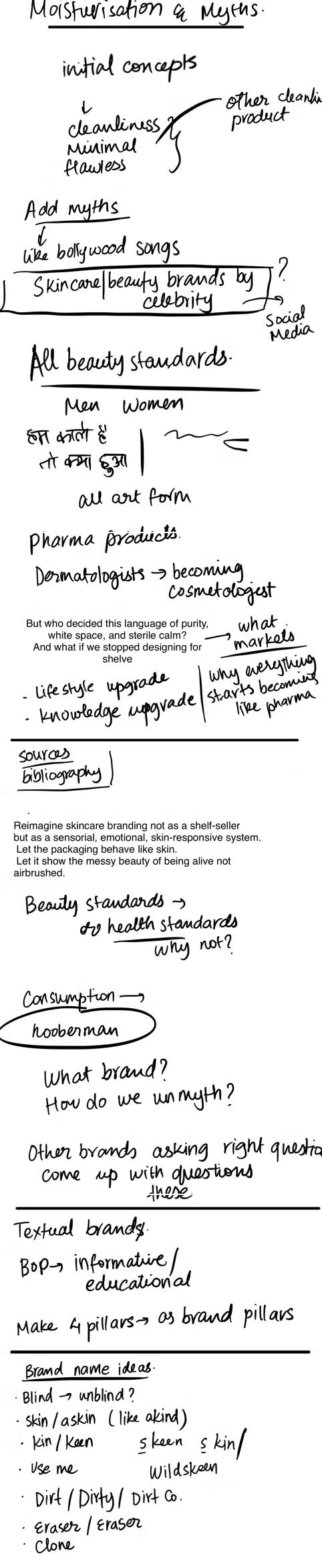
MYTHS WE MOISTURIZE
Clean = effective
Minimal = honest
Flawless skin = self-worth
Skincare must look like pharma to feel trustworthy But who decided this language of purity, white space, and sterile calm?
And what if we stopped designing for shelves


“Chaand Sa Roshan Chehra”
- Kashmir Ki Kali
“Gori Gori”
– Main Hoon Na
“Chittiyaan Kalaiyaan”
– Roy
“All about that bass”
- Meghan Trainer


Clean = Effective
The visual codes of “clean” white space, shine, sterility have become shortcuts for trust. But they often mask intensity, toxicity, or superficial performance. “Clean” isn’t a standard; it’s a strategy.
Minimal = Honest
Minimalism is framed as clarity. But it often reduces complexity into aesthetic quiet. When silence is mistaken for truth, design stops asking questions and starts avoiding them.
Flawless = Self-Worth
Flawlessness is positioned as a goal but also as proof of discipline, desirability, and success. It turns skincare into self-surveillance. The pressure isn’t just to care for your skin, but to control how it’s seen.
Pharma = Trust
Clinical packaging and sterile branding imply reliability. But visual authority can create emotional distance. Trust built on uniformity often leaves no space for nuance, expression, or care that feels personal.
Closing Thought
These myths have shaped the way we interpret design, products, and ourselves.
They reward what looks safe, silent, and smooth often at the cost of what’s real, responsive, and human.
Challenge
Reimagine skincare branding not as a shelf-seller but as a sensorial, emotional, skin-responsive system.
Let the packaging behave like skin. Let it show the messy beauty of being alive not airbrushed.
Not designing a skincare product but designing an opinion about how we’ve been told to look.
What if packaging wasn’t a surface to decorate, but a layer to feel?
What if design responded like skin - changing, reacting, expressing?
Skin isn’t static. It cracks, peels, flushes, scars, heals.
Real beauty isn’t consistent or polished, t’s responsive and alive.
Design shouldn’t hide that. It should hold it.
Design Opinion:
Skincare doesn’t just shape your skin.
It shapes what you’re told to fix.
Most products repeat that script.
Design can choose to question it.
Because this isn’t just about how you look
It’s about what you’ve been told to be.

Skin is in — now more than ever.
Over the last five years, applications for dermatology medical residencies have soared 50%, according to a Wall Street Journal report, in part thanks to the prevalence of “dermfluencers” online who boast millions of followers.
“People are much more aware about our field now,” NYC dermatologist Dr. Shereene Idriss told the Journal, pointing to the increased popularity of skincare on social media and the amount of time spent in virtual Zoom calls as reasons for the derm boom.


